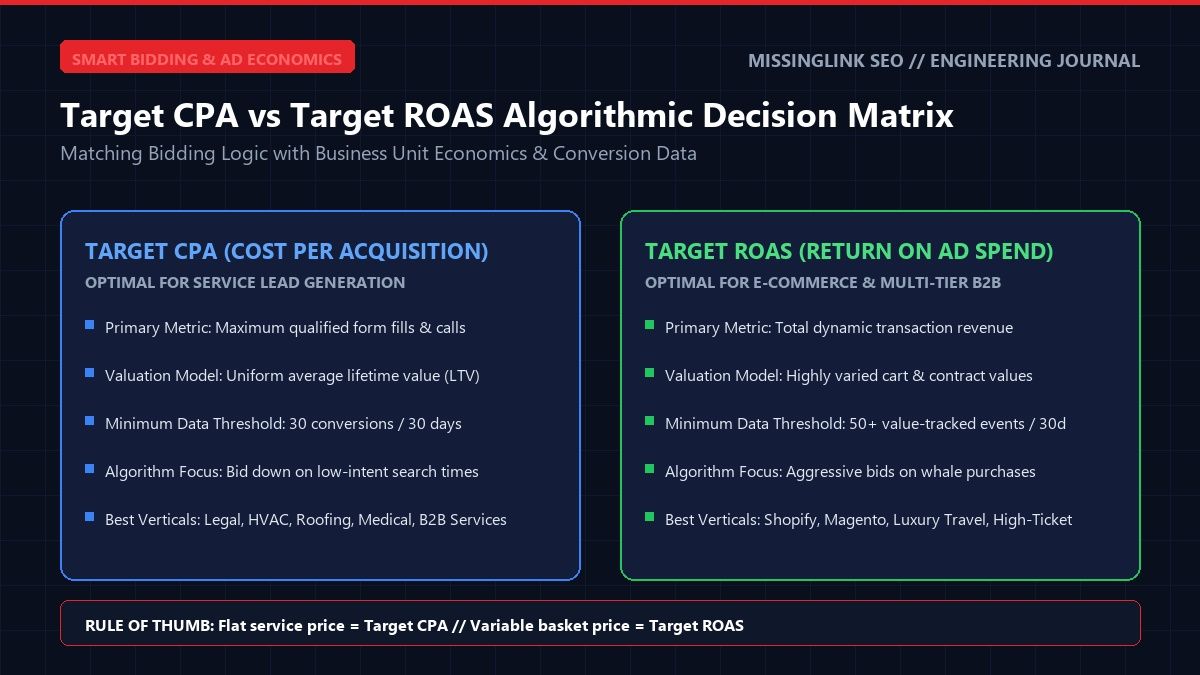
Google’s Smart Bidding infrastructure leverages multi-layered deep learning models that evaluate millions of real-time contextual signals at the exact millisecond of every ad auction. Specifically, these signals include user device, operating system, browser configuration, geographic location down to the postal code, query syntax, historical browsing patterns, and time of day. However, machine learning algorithms operate strictly as mathematical optimizers: they attempt to maximize the precise objective function you assign them.
Over the past 25 years engineering search engine marketing platforms and paid advertising funnels, I have observed numerous business owners struggle because they selected the wrong algorithmic bidding constraint. Specifically, deploying Target CPA (Cost Per Acquisition) when your revenue model demands Target ROAS (Return on Ad Spend)—or vice versa—stalls campaign delivery and inflates customer acquisition costs. As a result, choosing the correct mathematical framework is foundational to our Google Ads & PPC Management Services.
Mathematical Foundations: How Target CPA and Target ROAS Differ
To choose between these two bidding models effectively, you must understand their underlying loss functions. In practice, the strategic divide depends on whether your commercial revenue is uniform per customer or highly variable across transactions.
Target CPA functions under an equation constraint where total ad spend divided by total conversions must remain less than or equal to your pre-set dollar figure. In this environment, Google treats every recorded conversion identically. For example, whether an incoming lead turns into a $300 service repair or a $3,000 installation, the algorithm assigns equal mathematical weight to both outcomes. Therefore, Target CPA is ideal for lead generation businesses with predictable average ticket sizes.
In contrast, Target ROAS optimizes for monetary value rather than raw conversion count. Specifically, the objective function requires that total conversion revenue divided by total ad spend multiplied by 100 exceeds your target percentage. In addition, in this setup, Google bids aggressively when signals predict an enterprise purchaser or high-value basket, while pulling back on low-margin inquiries. As a direct result, Target ROAS is essential for online retailers and tiered B2B enterprises.
The Danger of Premature Smart Bidding Deployment
A frequent mistake made by inexperienced media buyers is launching a brand-new campaign and enabling Target CPA or Target ROAS immediately on day one. In reality, when Google's neural networks have zero historical conversion data, they lack the statistical confidence to forecast user conversion likelihood accurately.
As an immediate result, the algorithm enters a volatile bidding spiral. Specifically, it bids erratically on broad keywords and chokes ad impression share when early clicks fail to convert. To avoid this algorithmic starvation, our agency enforces a strict three-phase rollout sequence.
First, Phase 1 utilizes Manual CPC with Enhanced Bidding for the first two to three weeks. In practice, this allows us to harvest verified search term queries, eliminate negative keywords, and guarantee that conversion tracking tags fire flawlessly. In addition, we prevent automated bots and competitor click rings from draining the early budget, as outlined in our guide on PPC Click Fraud & Budget Waste Prevention.
Second, Phase 2 switches the campaign to Maximize Conversions once the account records at least 25 to 30 clean conversions. During this stage, the algorithm discovers the baseline conversion rate across various demographics and dayparts without restrictive bid caps.
Third, Phase 3 introduces Target CPA or Target ROAS constraints only after the campaign maintains steady conversion volume. Crucially, the initial target must be set within 10% to 15% of actual historical performance. Setting an overly aggressive target (such as demanding a $30 CPA when the actual average is $75) will cause Google's algorithm to stop bidding entirely.
Lead Generation vs. E-Commerce Strategic Implementation
For service businesses operating across Sarasota and Florida, Target CPA provides stable, predictable lead flow. For instance, an emergency air conditioning contractor might establish a Target CPA of $85 per phone call. Because the lifetime value of an AC customer includes seasonal maintenance and future system replacements, maintaining an $85 acquisition threshold guarantees healthy operating profit margins.
In contrast, e-commerce stores cannot rely on Target CPA because order values vary drastically. If a customer purchases a $25 phone accessory, a $50 CPA produces a heavy financial loss. However, if another customer orders a $1,200 commercial equipment package, that same $50 CPA represents an exceptional return. Accordingly, Target ROAS dynamically values each auction based on product margins. For brands scaling online storefronts, our specialized E-Commerce Agency Solutions integrate direct catalog syncs and dynamic conversion value tracking to maximize profit.
Conversion Rate Optimization as the Smart Bidding Multiplier
Many marketing teams treat Smart Bidding as an isolated media management task. In reality, Google's auction algorithm calculates your effective bid by multiplying your maximum willingness to pay by your landing page conversion probability and ad Quality Score.
Therefore, doubling your landing page conversion rate cuts your effective cost per acquisition in half without altering your bidding strategy. Specifically, implementing progressive micro-commitment forms—as detailed in our analysis of Multi-Step Lead Form Psychology—provides the algorithm with higher conversion density. As a direct result, Google rewards your account with cheaper auction placements and expanded impression share.
Beyond that, combining mathematical bid governance with the structural landing page standards explained in our guide on Anatomy of High-Converting Service Landing Pages creates compounding growth across paid campaigns.
Ultimately, to eliminate friction and maximize ROAS across your media spend, explore our complete Landing Page Design & Funnel Engineering solutions.
Related Engineering Blueprints & Service Pillars
Explore complementary technical guides and foundational service hubs from MissingLink SEO:
- Core Service Hub: Google Ads & PPC Management Services
- Specialized Service: E-Commerce Agency & Scaling
- Technical Article: PPC Click Fraud & Budget Waste Prevention
- Technical Article: Multi-Step Lead Form Conversion Psychology
Optimize Your Google Ads Smart Bidding Framework
Stop guessing your bid parameters. Jeff Coseo engineers mathematical Smart Bidding architectures that eliminate wasted budget and maximize your return on ad spend.
Request Free PPC Account Audit