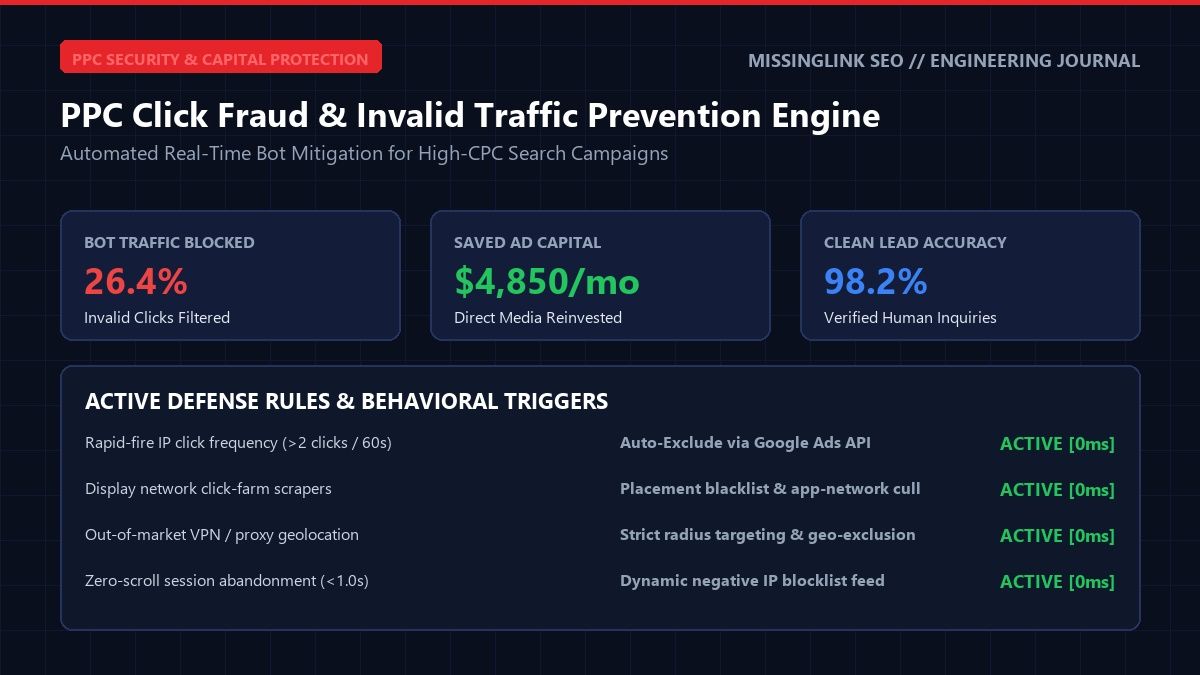
In highly competitive commercial search auctions—such as personal injury law, emergency roofing, commercial HVAC replacement, specialized healthcare, and wealth management—Google Ads search clicks routinely clear between $50 and $200+ per click. In auctions this lucrative, invalid traffic and malicious click activity represent a severe drain on client marketing budgets. Specifically, independent cybersecurity audits demonstrate that between 15% and 28% of total ad spend in high-CPC verticals is consumed by automated bots, competitor click rings, and scrapers.
Over the past 25 years engineering search engine marketing and custom web platforms, I have audited hundreds of Google Ads accounts suffering from unmonitored budget leaks. While Google provides automated filters for coarse invalid clicks, distributed bot networks utilizing residential proxies and headless browser automation easily bypass standard platform heuristics. Therefore, proactive defense engineering is mandatory for brands running aggressive media campaigns through our Google Ads & PPC Management Services.
The Anatomy of Paid Search Click Fraud: Three Primary Vectors
Understanding the exact pathways through which ad budgets are depleted allows for targeted technical mitigation. In practice, click fraud is rarely random; it follows structured economic incentives that harm honest advertisers.
First, competitor sabotage remains rampant in local and regional service markets. Rival operators or hired click contractors deliberately click your paid search ads repeatedly throughout the morning. As a result, your daily budget cap is exhausted by 10:00 AM, removing your company from the auction and allowing competitors to capture qualified afternoon inquiries at cheaper CPCs.
Second, low-tier search partner syndication networks generate artificial clicks to monetize publisher revenue-share models. Specifically, many low-quality affiliate sites embed automated scripts or trick visitors into clicking syndicated search ads. In addition, these clicks rarely lead to genuine inquiries, driving up customer acquisition costs.
Third, automated crawlers and commercial pricing scrapers browse search results through proxy clusters. For instance, these bots scrape competitor pricing, ad copy, and landing page offers, inadvertently clicking paid search links and charging the advertiser without any intent to purchase. As an immediate result, ad budgets evaporate without producing measurable pipeline growth.
Real-Time Behavioral Telemetry and Device Fingerprinting
In reality, waiting for Google's monthly invalid click credit adjustments is an ineffective financial safeguard. In practice, by the time Google reviews irregular traffic patterns weeks later, genuine prospective clients have already chosen competing businesses.
Specifically, our engineering team deploys real-time behavioral telemetry directly on client landing page infrastructure. For instance, when an incoming visitor arrives via a Google Ads click (verified by the `gclid` query parameter), our client-side monitoring script measures multiple physiological user indicators. For example, genuine human visitors exhibit curvilinear mouse trajectories, natural scroll velocity variations, and micro-pauses. In contrast, automated headless browser scripts (such as Puppeteer or Playwright) demonstrate rigid coordinate snaps, zero scroll deceleration, or instantaneous element clicks.
In addition, advanced device fingerprinting evaluates hardware canvas hashes, WebGL vendor strings, battery status APIs, and audio context characteristics. Therefore, when a specific device hash triggers multiple paid clicks within a short window, our edge server flags the session. As a direct result, malicious actors cannot evade detection simply by switching their IP address or clearing browser cookies.
Automated IP Exclusion via Google Ads API Webhooks
In practice, manual IP blocking in Google Ads is too slow to stop determined competitors. By the time a marketing manager manually inspects server logs and pastes an IP address into campaign settings, the daily budget has already been depleted.
Accordingly, we connect client landing page tracking directly to Google Ads campaign exclusion lists using automated API webhooks. Specifically, when our edge verification layer detects an invalid click signature—such as multiple paid visits within 60 seconds or a known data center ASN—the script immediately sends a mutation request to the Google Ads REST API. Therefore, the offending IP address and its associated subnet are blocked from viewing subsequent ad impressions within milliseconds of the first infraction.
Hard Campaign Settings: Eliminating Built-In Google Waste
In addition, beyond external bot mitigation, a substantial amount of PPC budget waste stems from default Google Ads campaign settings designed to maximize platform ad inventory rather than advertiser profitability. When building campaigns for clients in Sarasota and across Florida, we implement strict configuration safeguards.
First, we mandate strict Geographic Presence settings. By default, Google recommends targeting "Presence or interest: People in, regularly in, or who've shown interest in your targeted locations". In practice, this default setting causes ads to display to individuals searching from foreign countries or distant states who merely typed your city name into a query. Specifically, changing this setting to "Presence: People in or regularly in your targeted locations" instantly prevents out-of-market click leakage.
Second, we disable both Google Search Partners and Display Expansion on all high-intent search campaigns. Specifically, Google Search Partners bundles hundreds of secondary search engines and parked domain networks where click verification standards are substantially lower. Confining your budget purely to the core Google Search Network ensures every dollar targets active, intent-driven searches.
Third, we deploy expansive negative keyword lists. For instance, commercial contractors must exclude terms like "salary", "jobs", "certification", "free", "diy", and "internship". In addition, filtering non-commercial queries prevents casual searchers and job seekers from draining expensive clicks. To review how behavioral auditing identifies drop-offs on landing pages, consult our breakdown of Heatmap & Session Forensics: Pinpointing Friction in Mobile Funnels.
Data-Driven Smart Bidding Optimization
Fundamentally, clean traffic data is essential for the success of automated bidding algorithms. When bots and invalid clicks pollute your conversion tracking, Google's Smart Bidding machine learning optimizes around corrupt signals. As a direct result, the algorithm bids higher on traffic sources that fail to produce revenue.
In practice, once bot traffic is filtered out at the edge, smart bidding models function with mathematical precision. To understand the strategic choice between bidding frameworks, read our comparative guide on Target ROAS vs Target CPA: Mathematical Scaling Guide. In addition, combining pristine search traffic with optimized landing page architecture—as explained in our guide on Anatomy of High-Converting Service Landing Pages—ensures that every protected ad dollar drives maximum conversion yield.
Ultimately, to eliminate friction at the point of conversion, pair bot mitigation with modern Landing Page Design & Funnel Engineering that converts qualified visitors before they navigate away.
Related Engineering Blueprints & Service Pillars
Explore complementary technical guides and foundational service hubs from MissingLink SEO:
- Core Service Hub: Google Ads & PPC Management Services
- Specialized Service: High-Converting Landing Page Design
- Technical Article: Target ROAS vs Target CPA Mathematical Guide
- Technical Article: Anatomy of High-Converting Landing Pages
Stop Wasting Ad Spend on Fraudulent Clicks
Protect your Google Ads budget with custom edge detection and automated API exclusions engineered by Jeff Coseo. Maximize real client acquisition without budget leakage.
Claim Your Free PPC Forensic Audit