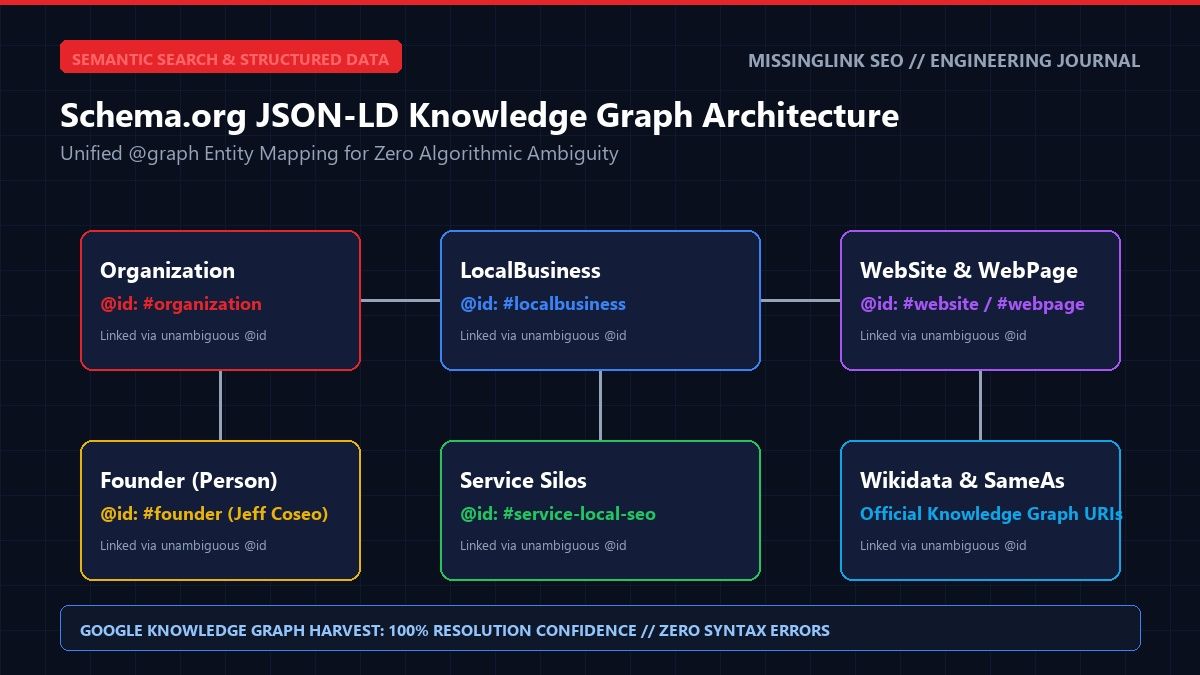
Specifically, deploying advanced blog schema markup has become essential as Google transitioned from a keyword indexer into an advanced probabilistic semantic knowledge engine. Rather than relying on simple keyword counts within raw HTML, contemporary search models like Gemini, RankBrain, and Search Generative Experience interpret the web through Entities. In particular, entities represent real-world people, organizations, places, products, and concepts connected by distinct topical relationships.
Therefore, deploying a unified Schema.org JSON-LD entity graph establishes algorithmic ground truth. In particular, Florida business owners executing Answer Engine Optimization (AEO) and organic campaigns eliminate ambiguity across crawlers. As a result, when search algorithms clearly identify your founders, services, headquarters, and verified credentials, your domain achieves sustained top-tier rankings in both traditional search results and AI answer summaries.
The Structural Failure of Fragmented Schema Markup
To begin with, most commercial websites implement structured data incorrectly by scattering detached schema blocks throughout separate page sections. For example, a website might inject an isolated Organization block in the header, a separate LocalBusiness block in a contact widget, and an unlinked Article block in the body.
Because these blocks lack explicit node linkage, search crawlers perceive them as conflicting, disconnected entities rather than a cohesive organization. As a result, search engines fail to pass topical authority between your brand, your leadership, and your published intellectual property.
Instead, professional search engineers assemble every semantic node within a single @graph array. Specifically, by connecting nodes via explicit @id URIs, you build a machine-readable knowledge graph directly within your source code:
Engineering the Master JSON-LD Entity Graph
In addition, to construct a durable entity graph, you must map the exact corporate hierarchy. Specifically, your graph should bridge your parent Organization, geographic LocalBusiness entities, founder profiles (Person), the website itself (WebSite), and the current page document (WebPage).
For instance, here is an enterprise-grade schema blueprint demonstrating how nodes reference each other via canonical identifiers:
{
  "@context": "https://schema.org",
  "@graph": [
    {
      "@type": "Organization",
      "@id": "https://missinglinkseo.com/#organization",
      "name": "MissingLink SEO",
      "url": "https://missinglinkseo.com",
      "logo": "https://missinglinkseo.com/assets/images/logo.webp",
      "founder": {
        "@type": "Person",
        "@id": "https://missinglinkseo.com/#founder",
        "name": "Jeff Coseo",
        "jobTitle": "Founder & Lead Growth Architect",
        "sameAs": [
          "https://www.linkedin.com/in/jeff-coseo/",
          "https://twitter.com/missinglinkseo"
        ]
      }
    },
    {
      "@type": "LocalBusiness",
      "@id": "https://missinglinkseo.com/#localbusiness",
      "name": "MissingLink SEO Sarasota",
      "parentOrganization": { "@id": "https://missinglinkseo.com/#organization" },
      "telephone": "+1-941-882-0808",
      "address": {
        "@type": "PostalAddress",
        "streetAddress": "1301 Main St",
        "addressLocality": "Sarasota",
        "addressRegion": "FL",
        "postalCode": "34236",
        "addressCountry": "US"
      }
    },
    {
      "@type": "WebSite",
      "@id": "https://missinglinkseo.com/#website",
      "url": "https://missinglinkseo.com",
      "name": "MissingLink SEO",
      "publisher": { "@id": "https://missinglinkseo.com/#localbusiness" }
    },
    {
      "@type": "WebPage",
      "@id": "https://missinglinkseo.com/blog-schema-markup-entity-graph#webpage",
      "url": "https://missinglinkseo.com/blog-schema-markup-entity-graph",
      "isPartOf": { "@id": "https://missinglinkseo.com/#website" },
      "about": { "@id": "https://missinglinkseo.com/#localbusiness" }
    }
  ]
}
Notice how the WebPage references the WebSite via isPartOf, while the WebSite references the LocalBusiness publisher. Meanwhile, the LocalBusiness links upstream to the primary Organization. This circular clarity prevents algorithmic hallucination.
Anchoring Authority with Wikidata and External sameAs Triangulation
While internal linking defines your site topology, external authority requires semantic grounding in global knowledge bases. Specifically, Google reconciles company claims against authoritative public ontologies like Wikidata, Wikipedia, Crunchbase, and official government registries.
For example, rather than simply writing that your business provides search engine optimization in Sarasota, you can tie your services to explicit Wikidata entity codes:
- Search Engine Optimization:
https://www.wikidata.org/wiki/Q180711 - Sarasota, Florida:
https://www.wikidata.org/wiki/Q842880 - Digital Marketing:
https://www.wikidata.org/wiki/Q1323528
Accordingly, by including these URIs inside the sameAs or knowsAbout properties of your founder and business entities, you establish unassailable mathematical consensus. As a result, search crawlers understand the exact industry vertical, geographic territory, and subject matter expertise associated with your domain.
Connecting Entity Authority to the Google Maps 3-Pack
Over the past 25 years of designing digital search infrastructures at MissingLink SEO, we have observed that entity graphs directly influence local pack rankings. Specifically, Google's local ranking algorithm weighs prominence and relevance heavily alongside geographic proximity.
For instance, when your website connects its schema graph to your exact Google Business Profile CID and coordinates, search algorithms confirm that your physical office at 1301 Main St in Sarasota is the authentic locus of your operations. In addition, pairing entity markup with consistent review velocity, as detailed in our guide on Google Review Velocity vs Volume, creates an insurmountable competitive advantage in the Google Maps 3-Pack.
Similarly, ensuring fast page load speeds through the methods outlined in our Core Web Vitals & INP Optimization Guide ensures crawlers can parse and index your structured data without timeouts.
Related Engineering Blueprints & Service Pillars
Explore complementary technical guides and foundational service hubs from MissingLink SEO:
- Core Service Hub: AEO & AI Answer Engine Optimization
- Specialized Service: Local SEO & Google Maps 3-Pack Optimization
- Technical Speed: Core Web Vitals & INP Optimization Guide
- Local Authority: Google Review Velocity vs Volume Guide
Ready for Enterprise Entity Architecture?
Deploy custom JSON-LD schema graphs engineered specifically for your business model with our complete AEO & Entity Marketing Services.
Claim Your Free Entity Audit