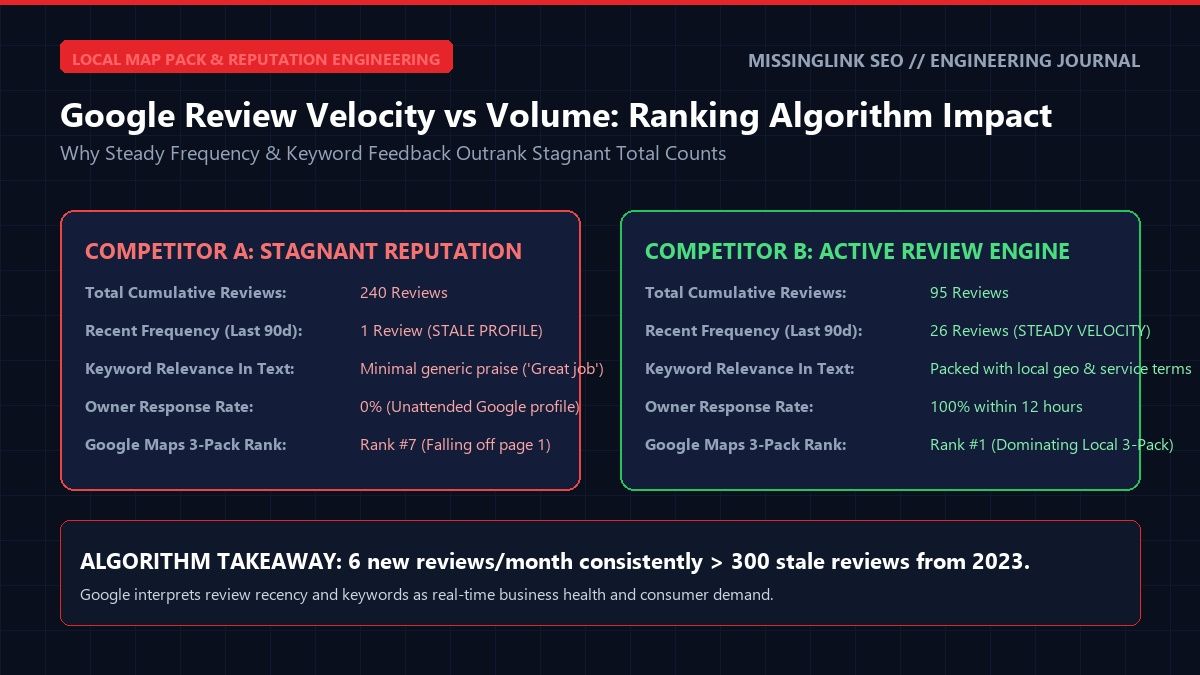
Specifically, a persistent misconception among local business owners across Florida is that Google Maps rankings rely exclusively on total cumulative review counts. For instance, many operators mistakenly believe that having 300 reviews guarantees perpetual dominance over a newer competitor with only 80 reviews. However, in Google's modern local search ecosystem, this static viewpoint leads to sudden ranking drops.
Therefore, understanding the mathematical distinction between Review Velocity (the continuous frequency of incoming feedback) and historical review volume is essential. In particular, Florida business leaders deploying Reputation Management & Review Acceleration Systems regularly outperform larger competitors. As a result, when Google's local neural networks detect steady, authentic 5-star reviews entering a profile every week, the business receives immediate ranking boosts across the competitive Google Maps 3-Pack.
Deconstructing the Local Search Algorithm: Cadence vs. Stagnation
To begin with, Google's local ranking algorithm is designed to prioritize businesses that actively satisfy modern customers. Specifically, when a company profile displays hundreds of positive reviews from two years ago but has received only three reviews in the past six months, search algorithms register operational stagnation.
Conversely, a local business generating three to five detailed reviews each week signals operational vigor and contemporary relevance. As a result, Google's algorithms reward the active profile with increased geo-grid coverage:
For example, in competitive industries like commercial roofing, personal injury law, and emergency HVAC, competitors fight over identical geographic boundaries. Specifically, when Google calculates whether to show your business to a searcher three miles away, high review velocity breaks local proximity deadlocks.
Semantic Keyword Indexing in Customer Testimonials
In addition, beyond star ratings, Google's Natural Language Processing (NLP) models evaluate the actual textual content inside customer reviews. Specifically, when customers write comprehensive feedback containing specific services—such as "custom commercial website architecture" or "technical search engine audit in downtown Sarasota"—Google extracts those phrases as third-party entity proof.
Because search algorithms distrust self-declared claims on corporate websites, customer reviews act as independent verification. In addition, when multiple independent customers mention specific services and geographic locations, your business entity solidifies its authority in local vector spaces.
Accordingly, to support this semantic validation, your technical foundation must match your local reputation. Specifically, by pairing customer reviews with the interconnected structure detailed in our Schema.org JSON-LD Entity Graph Strategy, you establish mathematical consistency across your website and Google Business Profile.
The Dangers of Review Gating and Artificial Velocity Spikes
Over the past 25 years of advising commercial businesses at MissingLink SEO, we have seen numerous companies penalized for review manipulation. Specifically, sudden artificial spikes—such as buying 50 reviews in a 48-hour period—instantly trigger Google's spam filters.
Similarly, review gating (filtering unhappy customers to private feedback forms while sending only happy clients to Google) violates Google Business Profile terms of service. As a result, when caught, businesses face severe penalties, including total review removal, account suspensions, or permanent removal from the Google Maps index.
Instead, sustainable ranking success requires automated, multi-channel customer workflows that ask every verified customer for feedback naturally. For instance, in our guide on Automated SMS vs Email Review Generation, we show how automated SMS workflows achieve 40%+ response rates by contacting clients immediately after project delivery.
Expanding the Google Maps Proximity Boundary
To illustrate, local businesses often struggle to rank in Google Maps outside their immediate neighborhood. For instance, an office located in Downtown Sarasota might rank #1 within 500 feet, but drop to position #14 just two miles away in Lakewood Ranch or Palmer Ranch.
However, steady review velocity directly expands your geo-grid ranking perimeter. As a result, when Google observes consistent client reviews originating from surrounding zip codes, its proximity threshold loosens, projecting your business into top 3-pack spots across entire regional territories.
Accordingly, combining review acceleration with our full-service Local SEO & Google Maps 3-Pack Services allows regional companies to dominate local search boundaries across Sarasota, Bradenton, and the Florida Suncoast.
Related Engineering Blueprints & Service Pillars
Explore complementary technical guides and foundational service hubs from MissingLink SEO:
- Core Service Hub: Reputation Management & 5-Star Reviews
- Specialized Service: Local SEO & Google Maps 3-Pack Optimization
- Automation Workflow: Automated SMS vs Email Review Generation
- Entity Architecture: Schema.org JSON-LD Entity Graph Strategy
Ready to Accelerate Your Google Review Velocity?
Implement automated review generation engines and dominate the Google Maps 3-Pack with our complete Reputation & Review Management Services.
Claim Your Free Reputation Audit