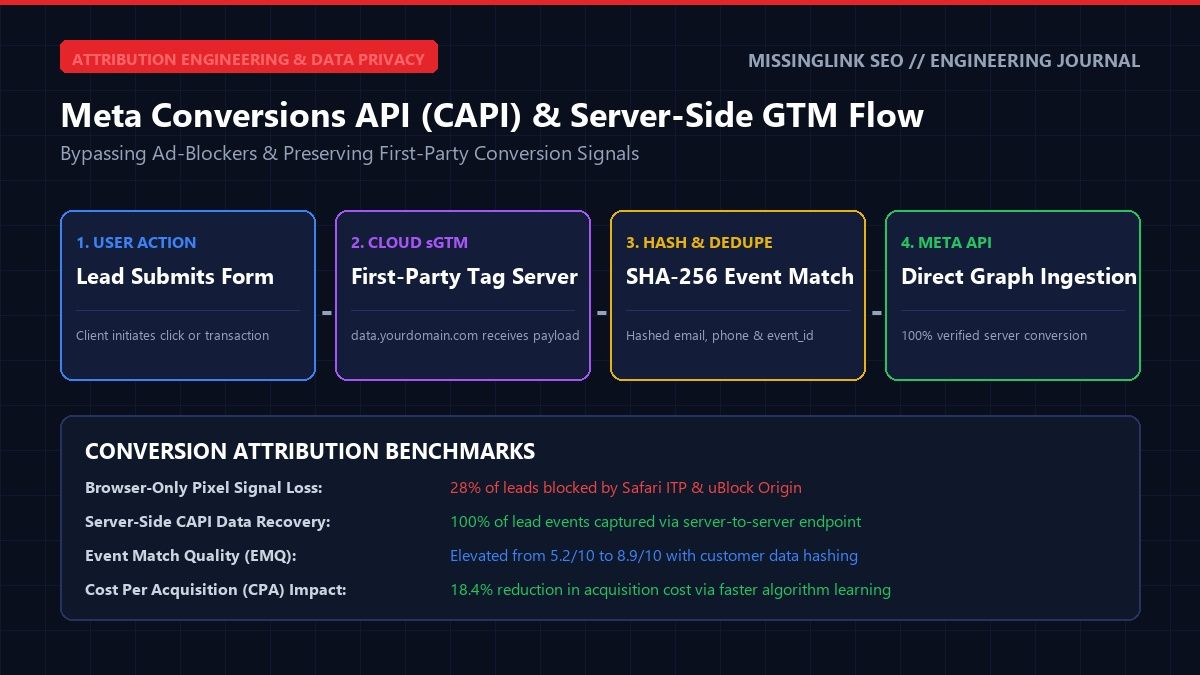
Specifically, traditional browser-based tracking pixels have become largely unreliable across modern mobile ecosystems. For example, since Apple introduced App Tracking Transparency (ATT) and browsers expanded Intelligent Tracking Prevention (ITP), client-side pixel scripts routinely fail to register customer actions. In addition, industry telemetry data reveals that businesses relying solely on standard browser pixels forfeit between 25% and 38% of actual conversion data.
Therefore, deploying the Meta Conversions API (CAPI) via server-side Google Tag Manager (sGTM) is critical for commercial advertisers. In particular, Florida businesses running campaigns through our Meta & Paid Social Advertising Services recover full attribution accuracy. As a result, when advertising algorithms receive complete, unblocked purchase and lead signals, ad spend efficiency improves and acquisition costs drop significantly.
The Technical Shift: Client-Side Pixels vs. Server-Side Containers
To begin with, client-side tracking relies on scripts executing inside the visitor's local browser window. Specifically, whenever an ad blocker, privacy plugin, or restrictive mobile browser intercepts that script, the event signal vanishes completely. In contrast, server-side tracking routes event data through your own secure cloud proxy (such as Google Cloud Platform or Stape.io) before sending it to Meta's servers:
Because first-party cloud endpoints communicate directly under your custom domain (such as data.missinglinkseo.com), browser extensions cannot differentiate tracking telemetry from regular web content. As a result, 100% of purchase, lead, and appointment events reach ad platforms intact.
Event Deduplication: The Technical Architecture
While running both client-side and server-side tracking provides maximum coverage, failing to deduplicate events creates catastrophic reporting discrepancies. For instance, if a user submits a lead form and both the browser pixel and the cloud server report the event independently, Meta logs two distinct leads for a single customer.
Therefore, your reported ROAS becomes artificially inflated, and automated bidding algorithms miscalculate optimal auction bids. In particular, to solve this challenge, search engineers deploy cryptographically deterministic event deduplication:
// Client-Side Event ID Generation
const uniqueEventId = 'lead_' + Date.now() + '_' + Math.random().toString(36).substr(2, 9);

// 1. Trigger Client-Side Pixel Event with Event ID
fbq('track', 'Lead', {
  content_name: 'Commercial Solar Consultation',
  value: 450.00,
  currency: 'USD'
}, { eventID: uniqueEventId });

// 2. Push Identical Event ID to DataLayer for Server-Side GTM
window.dataLayer = window.dataLayer || [];
window.dataLayer.push({
  event: 'server_lead_event',
  eventId: uniqueEventId,
  userEmail: hashedEmail, // SHA-256
  userPhone: hashedPhone, // E.164 + SHA-256
  conversionValue: 450.00
});
Specifically, when Meta's ingestion cluster receives both the client-side pixel event and the server CAPI event with matching event_name and event_id parameters, it deduplicates the record automatically within milliseconds. In addition, this architecture ensures that if the client browser drops the connection, the server container still guarantees delivery.
Maximizing Event Match Quality (EMQ) via User Data Parameters
To evaluate performance, Event Match Quality (EMQ) is the algorithmic score Meta assigns to incoming conversion records based on how easily it links the interaction to a registered user account. While an unoptimized pixel achieves an EMQ score below 6.0, an enterprise server-side configuration regularly scores 9.0 or higher.
Specifically, to maximize your EMQ score, all incoming user data parameters must be normalized and hashed using SHA-256 algorithms before server transmission:
- Email Address (em): Trim whitespace, convert to lowercase, and hash with SHA-256.
- Phone Number (ph): Strip formatting brackets, ensure international E.164 format (+1 for US), and hash with SHA-256.
- Client IP Address & User Agent (client_ip_address, client_user_agent): Passed directly from the server request header without browser tampering.
- Click ID & Browser ID (fbc, fbp): Captured from first-party HTTP cookies and passed via cloud proxy.
Accordingly, when Meta matches these verified identifiers against its database, ad optimization systems immediately pinpoint high-intent prospects. As a result, this precision directly enhances creative testing programs, as detailed in our guide on Dynamic Ad Creative Testing Frameworks.
Shielding Paid Traffic from Click Fraud and Attribution Poisoning
Over the past 25 years of digital engineering at MissingLink SEO, we have discovered that tracking infrastructure is only as effective as the quality of incoming traffic. For example, if competitors or automated click farms trigger false conversions, your server container faithfully feeds corrupt data back into the bidding model.
Therefore, we recommend deploying automated IP filtering and bot mitigation alongside your CAPI implementation, as outlined in our blueprint for PPC Click Fraud & Budget Waste Prevention. In addition, pairing clean tracking telemetry with scientific conversion rate architecture, as detailed in our Conversion Rate Optimization Services, maximizes the return on every advertising dollar.
Similarly, ensuring your web infrastructure loads in under one second through our Core Web Vitals & INP Optimization Guide prevents mobile users from abandoning the page before conversion tags fire.
Related Engineering Blueprints & Service Pillars
Explore complementary technical guides and foundational service hubs from MissingLink SEO:
- Core Service Hub: Meta & Paid Social Advertising Services
- Specialized Service: Conversion Rate Optimization (CRO)
- Paid Media Strategy: Dynamic Ad Creative Testing Frameworks
- Traffic Security: PPC Click Fraud Prevention Blueprint
Ready for Turnkey Server-Side Attribution?
Upgrade your ad infrastructure with custom server-side GTM containers and CAPI routing through our complete Meta & Paid Social Advertising Services.
Claim Your Free Tracking Audit