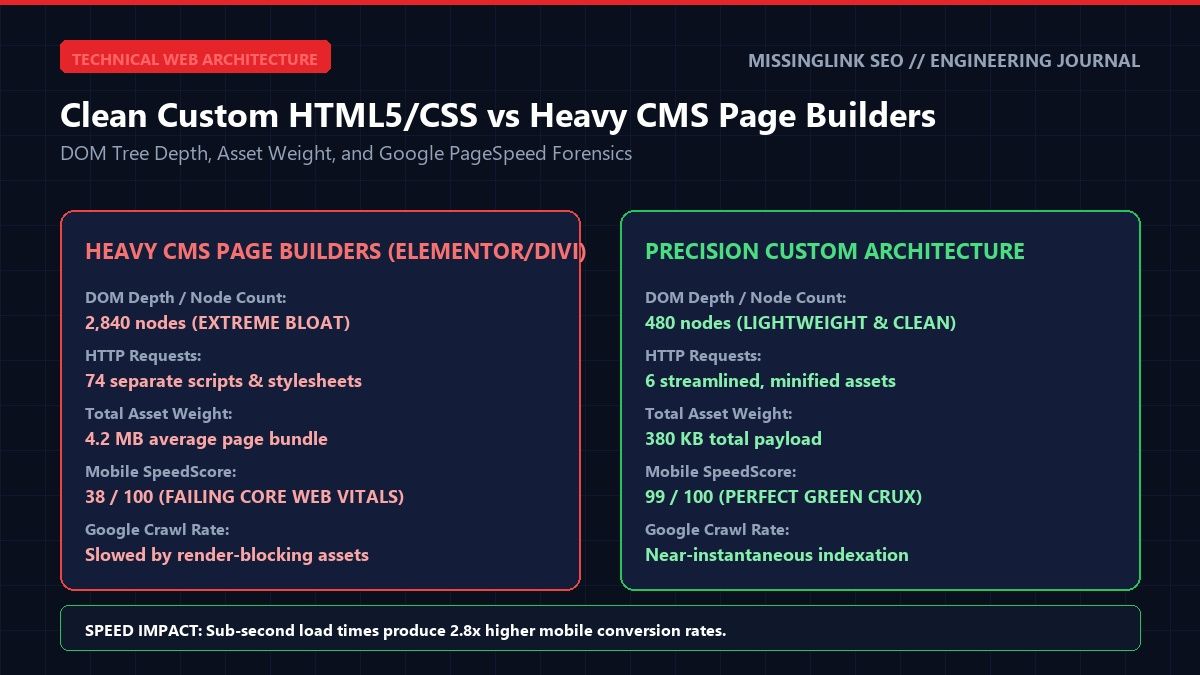
Specifically, commercial website development has split into two divergent philosophies. On one side, visual drag-and-drop page builders such as Elementor, Divi, and generic multi-purpose WordPress themes allow novice creators to assemble layouts quickly. On the opposing side, hand-engineered semantic code prioritizes performance, lightweight execution, and clean DOM architecture.
However, this builder convenience carries severe consequences for search engine rankings and user conversion rates. In particular, Florida companies seeking top search rankings through Custom Web Design Services must realize that bloated code structures directly degrade Core Web Vitals and slow down search engine discovery.
DOM Tree Forensics: Wrapper Bloat vs. Clean Semantic Markup
To begin with, visual page builders operate on generic abstraction layers designed to support infinite styling options. When a content editor places a simple text block inside a visual builder, the compiler generates multiple layers of nested container <div> elements with proprietary styling classes.
For example, a single headline in a builder template frequently requires seven nested parent tags. In contrast, custom semantic architecture uses a direct, unencumbered <h2> element styled through centralized CSS classes. As a result, page builder templates inflate the total DOM node count by up to 800%:
Because mobile devices rely on battery-constrained processors, executing thousands of unnecessary layout recalculations causes visible input lag. As detailed in our technical breakdown of Core Web Vitals & INP Optimization, complex DOM trees stall the main thread, pushing Interaction to Next Paint past Google's 200ms threshold.
Search Engine Crawl Budget and Indexation Velocity
In addition to hurting user experience, bloated page builders squander precious search engine crawl budget. Specifically, Googlebot allocates a limited amount of computing time to each website depending on server response latency and HTML complexity.
When search crawlers encounter megabytes of unminified CSS, redundant script libraries, and deep DOM nesting, crawl velocity grinds to a halt. As a result, critical product updates, new service pages, and authoritative articles can sit unindexed in the crawl queue for weeks.
Conversely, clean semantic HTML5 enables search bots to parse your document structure in fractions of a second. By combining streamlined HTML with a unified Schema.org JSON-LD Entity Graph, search engines instantly grasp your topical authority without processing irrelevant markup.
Security Vulnerabilities and Ongoing Plugin Debt
Over the past 25 years of web engineering at MissingLink SEO, we have seen businesses crippled by third-party plugin vulnerabilities. Specifically, visual page builders rely on expansive ecosystems of third-party add-ons, sliders, and form modules to function.
Because each additional plugin introduces external code dependencies, commercial sites become vulnerable to SQL injections, cross-site scripting (XSS), and breaking updates. Whenever WordPress or PHP updates, outdated builder extensions frequently break site layouts, resulting in costly emergency repairs and lost revenue.
Instead, custom-coded websites use lean, standardized PHP, clean JavaScript, and modular CSS without third-party reliance. Therefore, your digital infrastructure remains secure, immune to plugin deprecations, and fully compatible with future browser standards.
The Conversion Math: Why Milliseconds Dictate Revenue
While developer convenience benefits agencies churning out low-cost templates, website speed directly impacts your balance sheet. For instance, independent telemetry studies confirm that every 100-millisecond delay in mobile load time reduces conversion rates by up to seven percent.
When high-intent visitors click an advertisement or local search listing, they expect instantaneous response. If a heavy page builder forces visitors to stare at a blank screen for four seconds while parsing animation libraries, visitors bounce back to competitors. In our guide on High-Converting Landing Page Anatomy, we explore how clean code directly drives double-digit conversion gains.
Accordingly, businesses burdened by slow, fragile page builder setups should consider a complete migration. With our specialized Website Redesign & Modernization Services, we transition your digital presence to a high-speed custom foundation while preserving your established search rankings.
Related Engineering Blueprints & Service Pillars
Explore complementary technical guides and foundational service hubs from MissingLink SEO:
- Core Service Hub: Custom Web Design & UX Architecture
- Specialized Service: Website Redesign & Enterprise Modernization
- Technical Performance: Core Web Vitals & INP Optimization Guide
- Conversion Blueprint: Anatomy of High-Converting Landing Pages
Ready to Replace Sluggish Page Builders?
Modernize your business website with precision semantic architecture through our complete Custom Web Design & Engineering Services.
Claim Your Free Architecture Audit